I first met Lucas during the Gennetines festival in 2023, and from the very beginning I felt as if I had found a friend. I shared with him our initiative in Bulgaria and the struggles of building a young balfolk community. From that very first conversation, he was incredibly generous — offering ideas on how to reach more people, how to structure our work better, and how to grow sustainably.
We kept meeting at different festivals, and with time I began to understand just how highly professional he is in everything he does — and, at the same time, how much passion he has managed to preserve through the years. It’s genuinely inspiring.
Today I’m very happy that we get to collaborate and exchange knowledge. From Lucas being invited as a local expert at our events and supporting our development, to me being invited to job‑shadow their work during Dansstage — a festival I visited for the second year — I’ve seen firsthand the incredible amount of work they do. All of it fully voluntary. All of it driven by the love for folk.
Q: When did you first discover balfolk? Do you remember when you started dancing and what you liked about it?
A: I was around fourteen. A friend took me to a yearly local festival that brought together all the neighbours and farmers from the region. There was a band called The Eagles — at that time the biggest folk band in the Netherlands, with twelve members. They organised the festival and invited bands like La Machine, Quintet de Klerk, and others.
So my first years of dancing were simply there — dancing to some of the best bands without even realising how special it was. It was just dancing with my friends to great music.
Q: What was the name of that organisation?
A: Norbert. I think the festival might still exist, but the band that organised it no longer does. That was about twenty years ago.
Q: How would you define balfolk? What does it mean to you?
A: Balfolk began as a movement to preserve dances that were disappearing — or to revive dances that were already lost. Over time, it became a movement focused on preserving the feeling of dancing together, not necessarily the strict traditional forms.
For me, it’s a fusion: modern interpretations and modern music combined with traditional rhythms and steps. Above all, it’s a social event — a way for people to come together, like the village fêtes in France where people gathered to dance.
Q: How did Dansstage begin? How did you get involved?
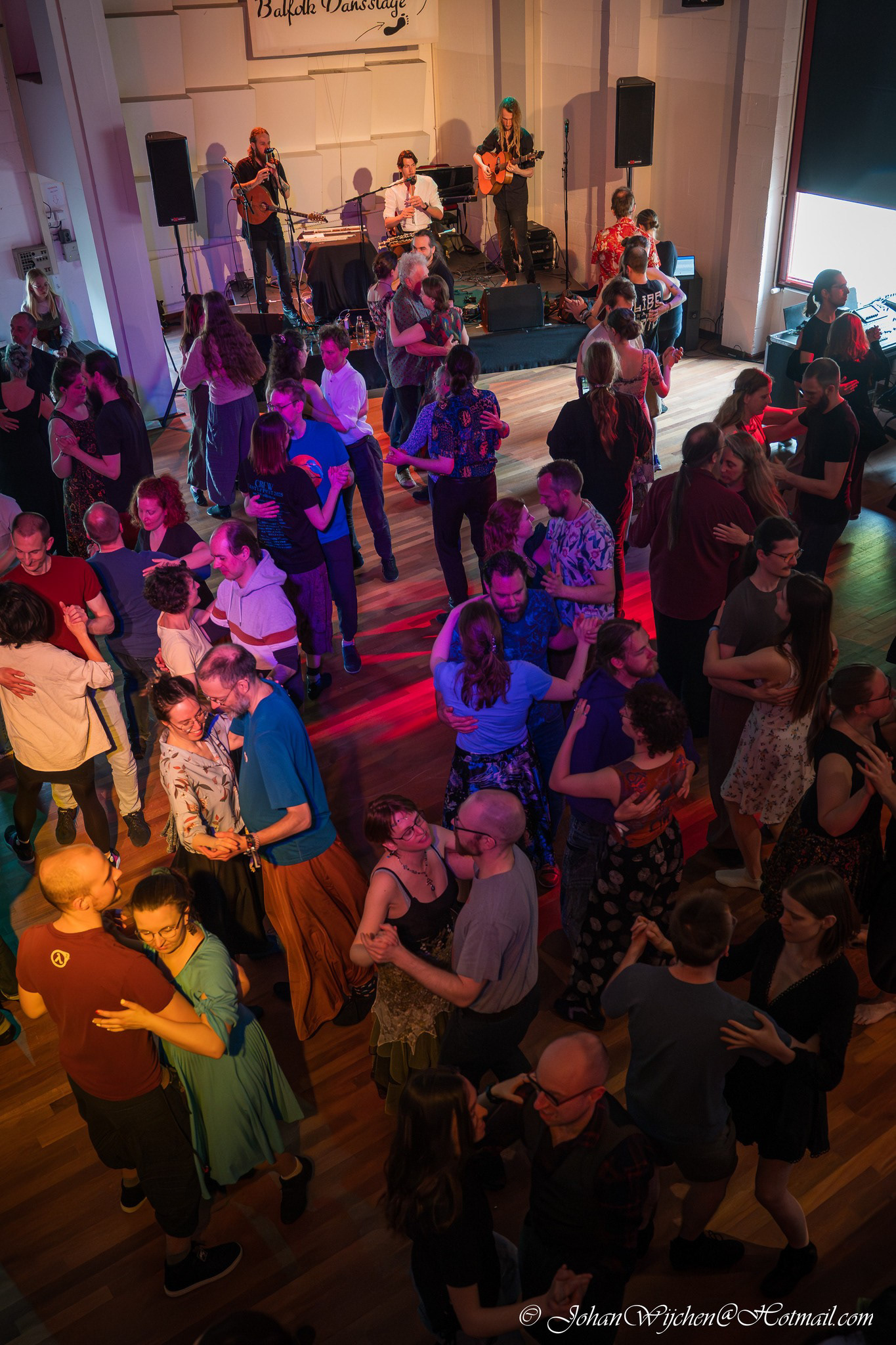
A: Before my time, teachers like Fereshteh and Luisa felt the need to organise something. This was about twenty‑two years ago. They rented a hall in a castle‑like monastery in Nijmegen and hosted the first weekend of workshops with a ball at the end. Participants could even sleep there.
They quickly realised the venue was too small, so they moved to Enschede. A few years later I joined, and since then it has grown steadily. Today we’re at the maximum capacity the campus can offer — around 250 participants and eight parallel workshops.
Q: Do you have a favourite festival — one that marked you in some way?
A: Many festivals are great, each for a different mood. Italy has a wonderful open atmosphere. Cadansa is cute and cosy. The Song Continues is fantastic for jamming and meeting musicians of all kinds — with some dancing on the side.
Q: How many people are currently in the Dansstage team? Are you friends or more like colleagues?
A: We’re six people at the moment. Three of us are close friends; the other three are good contacts from the folk scene. With some of them, we only interact during events — we say hi, but that’s it.
Q: How big is the balfolk community in the Netherlands? How is it structured?
A: I’d say around 2,000 people nationwide. But it’s not one unified community — it’s several hubs that partially overlap.
Amsterdam: a few hundred people centred around regular lessons; they mostly stay within the city.
Wageningen: the biggest hub — 200–350 people at events, coming from all over the country.
Groningen: a smaller group of a few dozen who mostly stay local.
Border region near Nijmegen: a long‑standing group dancing in the old style — hurdy‑gurdy, bagpipes, no amplification, very traditional.
So it’s not one community — it’s multiple communities.
Q: Is Dansstage aimed at the whole Netherlands?
A: Not specifically. For me, the target group is anyone, preferably international. Of course, many Dutch people come because it’s one of the two major festivals in the Netherlands. But we also get Germans, Belgians, and occasionally people from Canada, Ukraine, Poland, Spain, Italy, etc.
Q: How is the Dansstage team structured? Has it changed over time?
A: When I joined, it was chaos — three people doing everything, and then two left. The remaining organiser, Luisa, is very motivated but not good at structure, so she needed support.
Within a year we grew to four people, which we decided was the minimum. Now we have clear roles:
Treasurer, Food coordinator, Location contact, Equipment hire contact, Band & teacher contact (shared between two people), Tasks overlap intentionally. Everyone has a backup. For example, if the treasurer drops out, I can immediately take over. This redundancy is essential — last year one person got sick, and another stepped in seamlessly.
Q: Dansstage takes place on a university campus. Do students participate?
A: Not many anymore. In the beginning, yes — the organisers were students, so many students joined, and we even got discounts because it was partly a student event.
But during COVID, an entire generation of students left without engaging in campus culture. We lost continuity. Now maybe 20–30 students come to the open ball, and only two joined the workshops this year.
Q: Do you have regular workshops during the year?
A: We now have two events per year and hope to grow to four. But we don’t have strong teachers here — mostly hobbyists and volunteers. So regular lessons don’t attract many people.
Q: What about Dutch traditional folk music and dance? Is there overlap with balfolk?
A: Almost none. Dutch traditional dance was written down in the 1870s when people realised the tradition was disappearing. It became very strict and performance‑oriented. Social dancing exists, but it mixes Dutch and world dances (Israeli, etc.).
The scene is small and aging. They’re not interested in the improvisational, free spirit of balfolk. Sometimes they’re even jealous of our numbers. We’ve tried introducing traditional Dutch dances at balfolk events, but Dutch dancers and foreigners rarely want to learn them.
Q: Are there future plans for Dansstage? More days? New ideas?
A: No — it will not become longer. Some of us would love to create a completely different style of festival, but Dansstage is Dansstage. We’re tied to its format.
We’re also aware that the Netherlands has many amateur teachers — maybe a hundred people who call themselves teachers, but very few study the dances abroad or have strong foundations. Dansstage is the only major event in the Netherlands that brings international teachers with real roots in the traditions. This is crucial for the scene.
Q: Have you considered intensive workshops for people who want to become teachers?
A: We’ve thought about it, but it doesn’t work here. The people who truly know the dances are modest and don’t want to be in the spotlight. Meanwhile, the people who want to be teachers often lack knowledge — and they don’t absorb new information even when they attend workshops.
There is one person organising “teacher weekends,” but she herself has no solid base. Participants leave thinking they now have a foundation in balfolk, but they don’t.
Q: What, for you, defines a solid base in balfolk?
A: Most of balfolk is based on French traditions. Many teachers here have never been to the regions where the dances come from. Their knowledge is second‑hand — passed from person to person.
Even those who have visited the regions often went only once, without experiencing the real social context. Workshops can teach technique, but not the feeling or flow of a living tradition.
A few people have truly studied — living in France, spending full summers learning — but they’re not the ones seeking status. They teach when asked, but they don’t need diplomas.
Q: Balfolk today mixes many traditions. How do you see that?
A: The French influence is strong because, in the 1970s revival, France had the most material left — recordings, writing, living memory. But balfolk doesn’t need to be French. It’s contemporary folk: based on tradition, but not the tradition itself.
Some dances survived through old people’s memories, but even those are interpretations — an 80‑year‑old remembering how she danced at 20. Others were reconstructed from melodies whose original steps were lost.