«versión en español abajo»
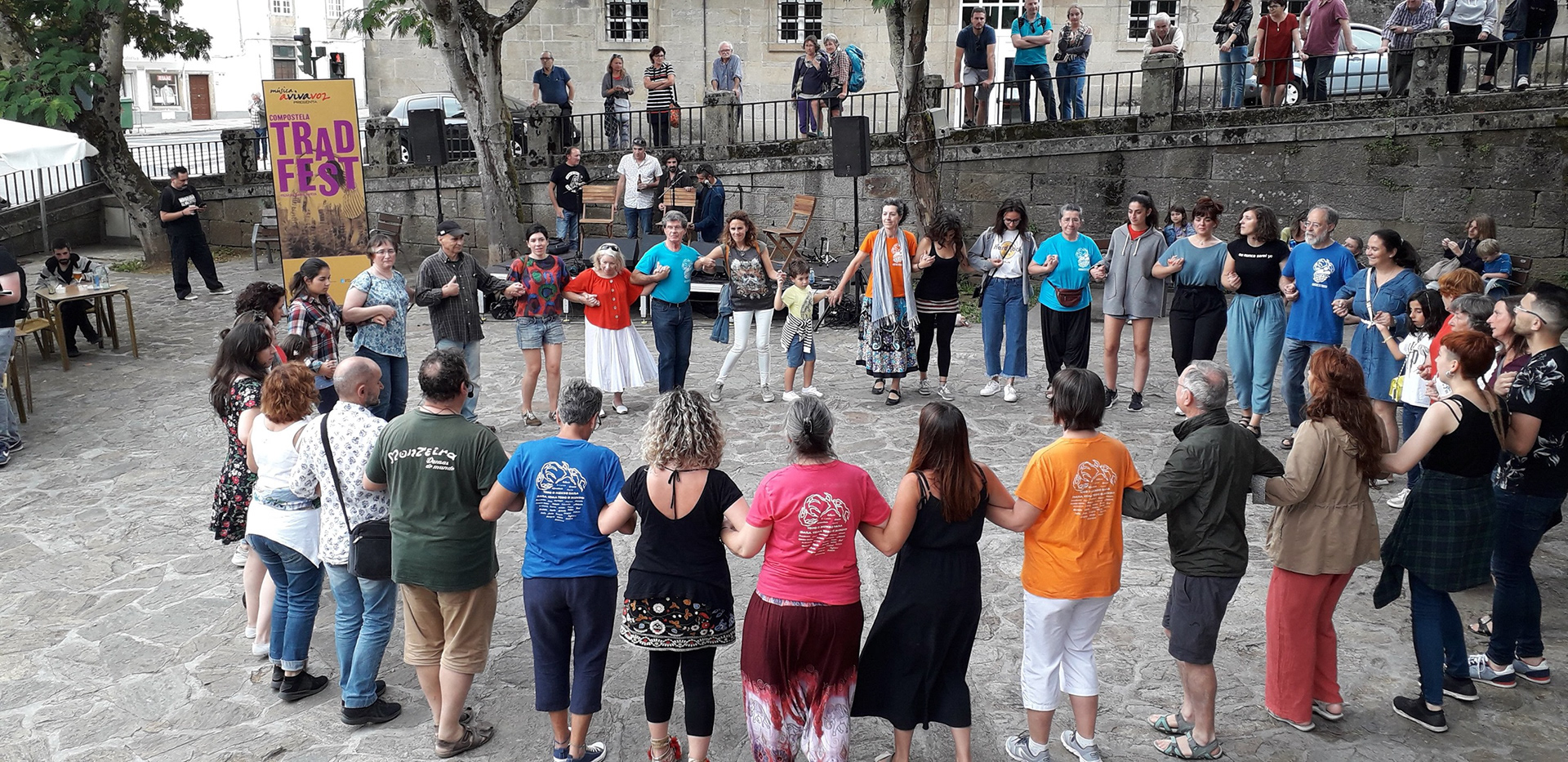
In 2018, after living for a year in Portugal, I moved to Vigo. I was looking for Galician dance, but I didn’t find it; what I did find was something far more important to me. I discovered the world‑dance association Monteira, located in the Asociación de Veciños da Salgueira “Rosalía de Castro”, just a short walk from home. They had dance classes twice a week. Dancing with them was incredibly inspiring: French dances, Romanian dances, Bulgarian dances… I loved feeling part of that community.
About five years later, we met again at the Interceltic Festival of Moaña. By then I was already dancing many world dances. The people from the organization recognized me — many remembered my name — and they made me feel completely at home. It was very funny that right afterwards I was heading to the Danzas sin Fronteras festival near Toledo, and when I mentioned it to Pilar, she offered to take me with her and her husband in their car. On the way, we talked endlessly about dance and festivals.
Two years later, I had the opportunity to return to give a Bulgarian dance workshop and to come accompanied by musicians from Bulgaria. Together with Monteira, we organized a beautiful event — a blend of Galician and Bulgarian music for dancing — which was very special for all of us.
Today I’ve come back with another mission. Since Monteira was my first world‑dance school, and now I have my own association, it made perfect sense to talk to them, to understand how they built such a beautiful community and to learn from their experience. In March 2026, I came to take a few workshops with them, to see each other again, to watch their rehearsal for the Festival da Reconquista, and to have a coffee with Jesús Cancelas to talk about how it all began.
Here is part of the story…
1. What was your first encounter with world dances? Do you remember the moment you started dancing? What drew you in, and what does it mean to you today?
I started dancing when I was about fifteen, because a friend took me to Galician dance classes. He stopped dancing almost immediately, but I stayed because I loved it. What caught my attention was that here people danced mostly to perform, to go on stage, and very little simply to enjoy the dance itself.
The big change came when I went to the Festival Interceltique de Lorient in France. I went thanks to a raffle, with a friend, and there I discovered another way of dancing: simple, social, without pressure, where people gather just to enjoy themselves. I fell in love with that. I fell in love with Brittany, with the festivals, with the community that forms through dance.
From then on, I started traveling a lot, learning new rhythms and new styles — and coming back to share them.
2. How was the Monteira initiative born? What inspired you to create it, and what were the first steps? What challenges did you face?
When I came back from my first festivals, the Danzas sin Fronteras festival already existed in Spain, created by Javier Muela and his community. That inspired me a lot. He came to teach workshops in Vigo and A Coruña, and little by little people started gathering — people who enjoyed learning new dances and sharing them — and the two world‑dance communities in Galicia were formed.
For many years we worked informally, simply because we loved it. After a few years, I decided to officially register the Monteira association, mainly to access grants from the Xunta and to hire musicians and guest teachers. That allowed us to grow.
The main challenge has always been the same: you never know how many people will come. And also that here people want to learn quickly, without complications. Teaching more complex rhythms, like Balkan ones, requires patience — and not everyone has it. Another difficulty today is bringing new people into dancing. Many of us who dance now have been dancing together since the beginning, already 30 years ago.
3. Is there a festival that marked you in a special way? What was your gateway into the folk world?
Without a doubt, the Saint Chartier festival was my gateway. There I discovered that dance could be social, free, without a stage. It was love at first sight. Later I fell in love with Brittany and began traveling constantly to festivals across Europe.
4. Creating community is the hardest part… how did you manage it? What do you think people look for when they arrive — and stay?
The community was born from the people who traveled with me. We shared dances, discoveries, new music. There was no plan — we simply enjoyed dancing and learning together.
I think the people who stay are looking for that: a space where you can dance without competing, without performing, without pressure. A place where you can make mistakes, laugh, learn new rhythms, and travel through dance.
It also helps that we always try to bring musicians and teachers from abroad, collaborate with different groups, and mix styles. That keeps the community alive.
Also, twice a year (in May and October), we gather in Carballiño to enjoy 72 hours of dance and music. We share the organization of the xuntanza with the other dance association: one year we organize it, the next year they do. It’s a great way to keep the tradition alive and strengthen the bonds within the community.
5. How is Monteira’s programming structured today? And how was it in the beginning?
Today we have workshops in two different locations, we collaborate in events like the Reconquista, we organize social dances — sometimes with bagpipes — and we invite teachers from Romania, Macedonia, and other countries. We also collaborate with local and visiting musicians.
In the beginning, everything was much more spontaneous: we gathered to share what we had learned at festivals. There was no structure, only enthusiasm.
6. What is Monteira’s relationship with the folklore of Galicia and the rest of Spain? Are there exchanges or influences?
I started by dancing Galician folk, and I always liked it. But I also noticed that many people here danced only to perform, not to enjoy. Over time, I learned to appreciate the folklore of all of Spain, including flamenco, which in certain circles used to be seen as “old‑fashioned” because of its association with Francoism.
At Monteira we do a bit of everything: Galicia, Brittany, the Balkans, Greece… We always try to learn from everywhere. And yes, we collaborate with musicians and groups of different styles.
What dreams do you have for Monteira? Any ideas still waiting for their moment? Something you dream of creating one day?
Talking with Suso and reconnecting with the Monteira community was incredibly inspiring. Once again, I was welcomed with so much love and warmth. It’s interesting how all our organizations face similar challenges when creating new culture: attracting people, finding funding, and showing that the world of folk dances has enormous value and teaches us so much.
It was exciting to discover that Suso experiences travel and dance in a way very similar to mine. Today, what I do in Bulgaria and everywhere I travel where there is social folk music and dance is not about performing — it’s about sharing. Stage dance and music are beautiful, but I’m not drawn to the competitive energy or the perfectionism that sometimes appear in the stage‑folk world.
I deeply believe in music and dance as ways of sharing and learning informally from one another. And it is always very special to find people who feel the same.